
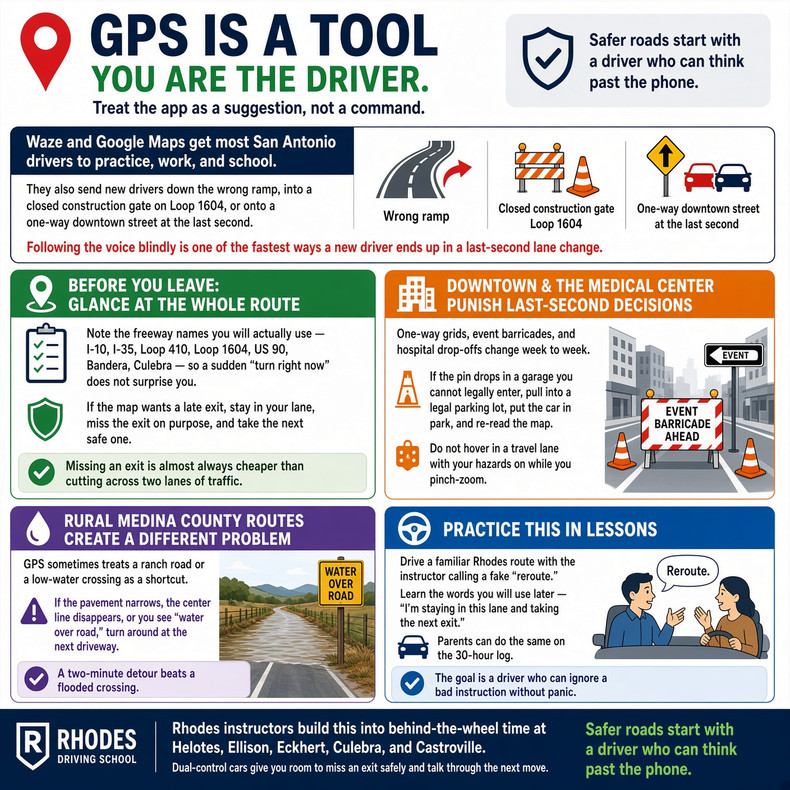
Waze and Google Maps get most San Antonio drivers to practice, work, and school. They also send new drivers down the wrong ramp, into a closed construction gate on Loop 1604, or onto a one-way downtown street at the last second. Following the voice blindly is one of the fastest ways a new driver ends up in a last-second lane change.
Treat the app as a suggestion, not a command. Before you leave, glance at the whole route. Note the freeway names you will actually use — I-10, I-35, Loop 410, Loop 1604, US 90, Bandera, Culebra — so a sudden “turn right now” does not surprise you. If the map wants a late exit, stay in your lane, miss the exit on purpose, and take the next safe one. Missing an exit is almost always cheaper than cutting across two lanes of traffic.
Downtown San Antonio and the Medical Center punish last-second decisions. One-way grids, event barricades, and hospital drop-offs change week to week. If the pin drops in a garage you cannot legally enter, pull into a legal parking lot, put the car in park, and re-read the map. Do not hover in a travel lane with your hazards on while you pinch-zoom.
Rural Medina County routes create a different problem. GPS sometimes treats a ranch road or a low-water crossing as a shortcut. If the pavement narrows, the center line disappears, or you see “water over road,” turn around at the next driveway. A two-minute detour beats a flooded crossing.
Practice this in behind-the-wheel lessons: drive a familiar Rhodes Driving Schools route with the instructor calling a fake “reroute.” Learn the words you will use later — “I’m staying in this lane and taking the next exit.” Parents can do the same on the Texas 30-hour practice log. The goal is a driver who can ignore a bad instruction without panic.
Rhodes instructors build this into in-car time at Helotes, Ellison, Eckhert, Culebra, and Castroville. Dual-control cars give you room to miss an exit safely and talk through the next move. Safer Roads with Rhodes starts with a driver who can think past the phone.