
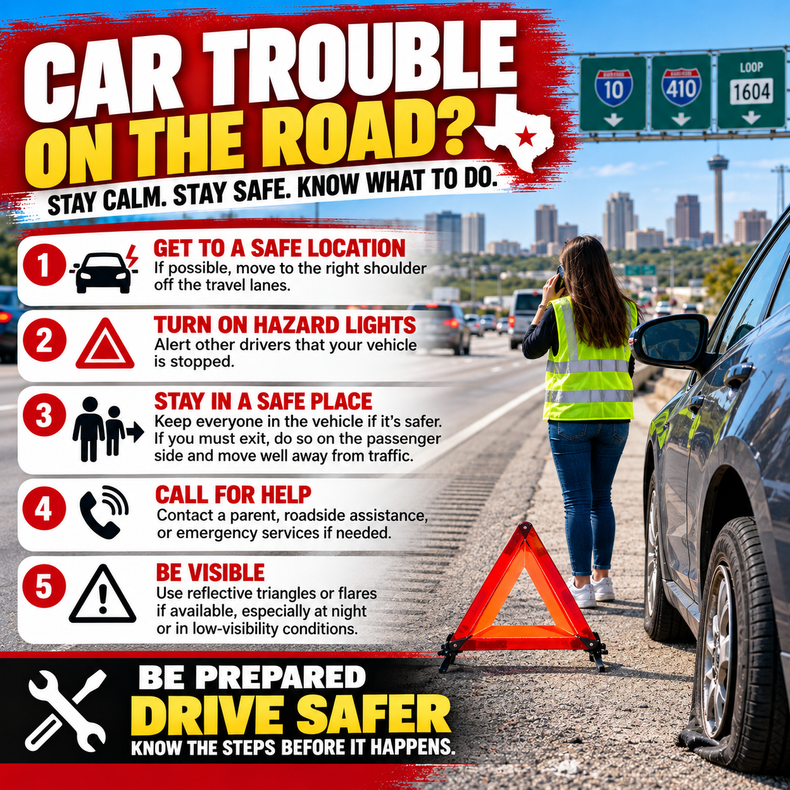
A flat tire, overheating engine, or sudden mechanical issue on the side of the road is one of the more stressful situations a new driver can face. On busy San Antonio freeways such as I-10, Loop 410, or Loop 1604, or on two-lane roads west of the city near Castroville and Medina County, the combination of speed, limited shoulders, and passing traffic raises the risk.
Knowing the steps ahead of time helps a new driver stay calm and reduce danger for everyone involved. These procedures are covered in Rhodes Driving Schools private lessons and defensive driving courses so students are not learning them for the first time during an actual breakdown.
Immediate Steps When the Vehicle Fails
- Signal and move right as soon as it is safe.
Use your turn signal and ease toward the right shoulder. On multi-lane roads, do not stop in a travel lane if you can reach the shoulder. On two-lane FM roads or US 90 west of Loop 1604, pull as far off the pavement as the shoulder allows without dropping into a ditch. - Turn on your hazard lights.
Activate them immediately so approaching drivers can see you. In Texas, hazard lights are the clearest signal that you are stopped and not simply pulled over for another reason. - Decide whether to stay in the vehicle or exit.
- On high-speed roads (I-10, Loop 1604, Loop 410) with heavy traffic and narrow shoulders, staying inside with your seat belt on is often safer.
- If you must exit, do so on the side away from traffic. Stand behind a guardrail or as far from the roadway as possible.
- Never stand between your vehicle and traffic.
- Call for help.
Use your phone to contact roadside assistance, a parent, or 911 if the situation is dangerous (for example, if the vehicle is partially in a travel lane or you are on a curve with poor visibility). Texas law requires other drivers to move over or slow down for a stopped vehicle with flashing lights, but you should not rely on every driver complying.
Texas Move Over or Slow Down Law
Texas requires drivers to move over one full lane or, if that is not safe, slow to 20 mph below the posted speed limit when approaching an emergency vehicle, tow truck, TxDOT vehicle, or other service vehicle stopped with lights flashing. The same protection applies once your hazards are on.
New drivers should know two things:
- Other drivers are legally required to give you space.
- Not every driver will do it correctly, so you still need to position yourself as safely as possible.
Fines for violating the Move Over law can reach $1,250 or more, especially if a crash results. Rhodes instructors review this law during lessons so students understand both their rights and their responsibilities when they are the ones driving past a stopped vehicle.
What to Do While Waiting
- Stay visible. Keep hazards on. If you have reflective triangles or flares and can place them safely behind the vehicle (roughly 100–200 feet back on higher-speed roads), do so.
- Do not attempt major repairs on the shoulder of a busy road. Changing a tire on Loop 1604 or I-10 is significantly more dangerous than waiting for a tow.
- Keep your phone charged. A portable charger in the glove box or center console is useful.
- If the vehicle is overheating, do not open the radiator cap while it is hot. Shut the engine off and wait for help.
- Note your location as accurately as possible (mile marker, nearest exit, cross street, or GPS pin) when you call for assistance.
Common Breakdown Causes New Drivers Should Watch For
Many roadside stops are preventable with basic maintenance:
- Low tire pressure or worn tires (especially in Texas heat).
- Low coolant or a failing water pump that leads to overheating.
- A dead battery or alternator issue.
- Running out of fuel (more common than many new drivers expect on longer rural drives).
Rhodes Driving Schools encourages parents and students to perform a simple monthly walk-around and to address warning lights promptly. An oil-pressure or temperature light that is ignored can turn a short drive into a roadside stop.
Practice and Preparation
Parents can reinforce these steps during supervised practice:
- Review the sequence in the driveway before the first longer drive.
- Point out safe shoulder areas on familiar routes.
- Confirm the vehicle has a working spare, jack, and basic emergency kit.
- Make sure the new driver knows how to contact roadside assistance or a parent quickly.
A focused private lesson with a Rhodes instructor can include a controlled discussion and practice of emergency procedures so the response becomes more automatic.
Quick Reference Checklist
- Signal and move as far right as possible.
- Hazard lights on.
- Stay in the vehicle if traffic is heavy and the shoulder is narrow.
- Call for help and give a clear location.
- Do not stand in the roadway.
- Rely on the Move Over law but do not assume every driver will comply.
A breakdown is inconvenient. It does not have to become dangerous if the driver has a clear plan. Rhodes Driving Schools helps students build that plan through instruction at Helotes, Ellison, Eckhert, Culebra, and Castroville.
Contact the location nearest you to schedule a lesson that includes emergency procedures and highway skills.
Helotes: (210) 695-8883
Ellison: (210) 680-3980
Eckhert: (210) 523-7483
Culebra: (210) 233-1094
Castroville: (830) 931-6116