
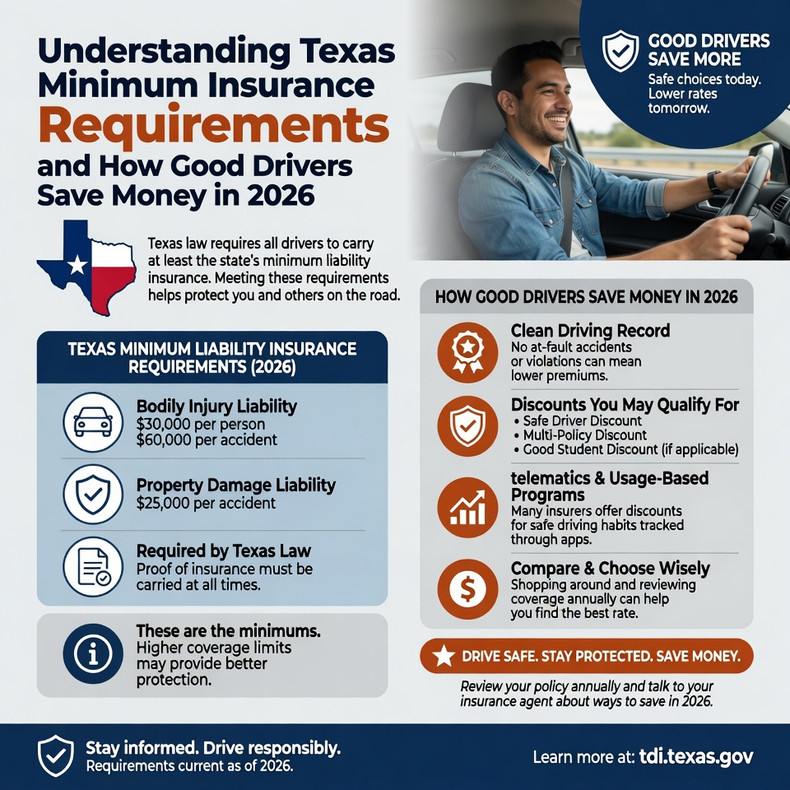
Texas law requires every driver to carry at least minimum liability insurance. For new teen drivers and their families, insurance is often one of the largest ongoing costs of getting a license. Rates for newly licensed drivers are typically high because insurers know that the first years behind the wheel carry elevated risk. The good news is that smart habits, a clean record, and professional driver training can help control those costs.
Here is what every new San Antonio driver and parent should understand about Texas auto insurance in 2026:
- Know the state minimum liability limits. Texas currently requires 30/60/25 coverage. That means at least $30,000 for bodily injury per person, $60,000 for bodily injury per accident, and $25,000 for property damage. These are the legal minimums. Many families choose higher limits for better protection.
- Professional driver’s education can help with discounts. Completing a state-approved drivers education course, such as those offered at Rhodes Driving Schools, is often recognized by insurance companies. A clean record combined with professional training frequently qualifies teens for better rates than parent-taught only programs.
- Take advantage of available discounts. Common discounts include good-student discounts for maintaining solid grades, multi-car or multi-policy discounts when the teen is added to a family policy, and sometimes discounts for completing a defensive driving course. Ask your agent specifically about teen and student discounts.
- Protect your driving record from day one. Tickets and at-fault crashes raise insurance rates, often for three years or longer. Speeding, distracted driving, and following too closely are common ways new drivers see their rates jump. Safe habits keep costs down.
- Never let coverage lapse. Driving without insurance is illegal in Texas and can lead to fines, license suspension, and much higher future insurance costs. Even a short lapse can be expensive.
- Understand the main types of coverage. Liability covers damage or injury you cause to others. Collision covers damage to your own vehicle in a crash. Comprehensive covers non-crash events such as theft, hail, or hitting an animal. Liability is required; the others are optional but often recommended.
- Shop carefully but stay covered. Rates can vary significantly between companies. Compare quotes, but make the decision based on both price and the company’s claim service. Switching for a lower rate is fine as long as there is no gap in coverage.
- Talk with your insurance agent early. Before the teen begins driving or as soon as the provisional license is issued, have a clear conversation about how the new driver will affect the policy and what steps can keep the premium as reasonable as possible.
Rhodes Driving Schools students often benefit when families speak with their insurance providers. Insurers generally view structured, professional training more favorably than informal practice alone. Our curriculum focuses on the exact habits — attention, space management, and decision-making — that help keep both crash risk and insurance costs lower over time.
Safer Roads with Rhodes! Give your teen the training that supports both safety and smarter insurance outcomes. Visit rhodesdrivingschools.com or contact any of our four San Antonio locations — Helotes, Ellison, Eckhert, or Culebra — to get started.