
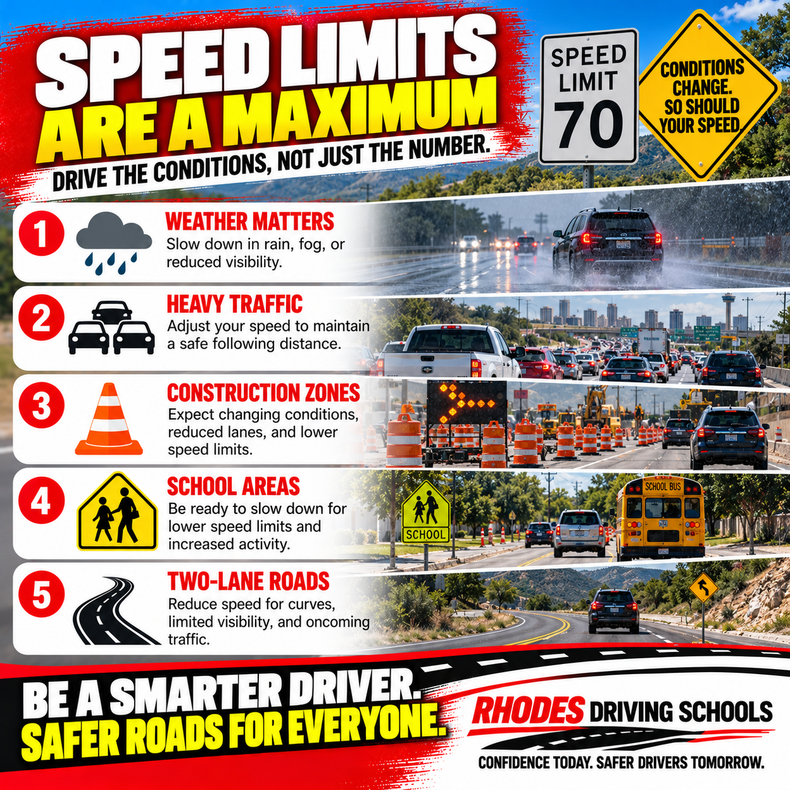
The posted speed limit is the maximum legal speed under ideal conditions. It is not a target that must be reached in every situation. New drivers in San Antonio, Castroville, and Medina County regularly encounter rain, heavy traffic, construction zones, school areas, limited visibility, and two-lane roads where driving at the posted limit increases risk. Learning to adjust speed to conditions is a core defensive-driving skill that reduces both crashes and citations.
Rhodes Driving Schools instructors emphasize “drive the conditions, not just the number on the sign” during private lessons and defensive driving courses. Students who practice this judgment handle changing road environments more safely.
What the Law Expects
Texas law requires drivers to operate at a speed that is reasonable and prudent for existing conditions, even when that speed is below the posted limit. Factors that require a reduction include:
- Weather (rain, fog, standing water)
- Traffic density
- Road surface and visibility
- Presence of pedestrians, cyclists, or school zones
- Construction or maintenance activity
Driving the posted limit in clearly hazardous conditions can still result in a citation for unsafe speed or contribute to fault in a crash. Conversely, driving significantly below the flow of traffic without reason can also create hazards; the goal is an appropriate speed for the situation, not an arbitrarily low one.
Common Situations That Require Slower Speeds
Rain and wet roads
The first minutes of rain on San Antonio freeways and surface streets often leave oil residue that reduces traction. Standing water increases hydroplaning risk. Reduce speed and increase following distance well beyond the normal 3-second rule (4–6 seconds or more in heavier rain).
Construction zones
Work zones on I-10, Loop 410, Loop 1604, and major surface streets frequently have reduced speed limits. Fines are doubled in many active construction areas. Even when workers are not present, lane shifts, uneven pavement, and narrowed lanes require lower speeds.
School zones and high-pedestrian areas
Flashing lights or posted school-zone speeds must be obeyed. New drivers should also slow in areas with heavy foot traffic near campuses, parks, or shopping areas even outside formal school-zone hours.
Limited visibility
Fog, heavy rain, dawn/dusk glare, or driving toward a low sun on east-west roads (including portions of US 90) reduces the distance a driver can see and react. Speed should drop so the vehicle can stop within the visible distance.
Two-lane and rural roads
On US 90, FM 471, and other Medina County routes, sight lines can be shorter, shoulders narrower, and wildlife or farm equipment more common. The posted limit assumes good conditions; curves, hills, and oncoming traffic often require a lower speed.
Heavy or stop-and-go traffic
Maintaining a safe following distance sometimes means driving below the posted limit when traffic ahead is slower or compressing. Closing the gap to “keep up” is a frequent cause of rear-end crashes.
How to Practice Speed Adjustment
During supervised practice hours, parents and instructors can:
- Point out changing conditions and ask the student what speed feels appropriate before stating the answer.
- Practice the same route in different conditions (dry vs. light rain, light vs. heavier traffic) so the student experiences the difference.
- Use following-distance counting as a real-time check rather than relying only on the speedometer.
- Review any close calls or hard braking afterward to identify where speed was too high for the conditions.
A private lesson can focus on highway speed management, construction-zone driving, or rural two-lane roads so the student receives immediate feedback.
Road-Test and Everyday Relevance
Examiners observe whether a driver adjusts speed appropriately for curves, intersections, weather, and traffic. Driving the posted limit through a situation that clearly calls for a reduction can result in a deduction or failure. In daily driving, the same judgment prevents the majority of speed-related crashes involving new drivers.
Quick Reference for New Drivers
- The posted limit is the maximum under ideal conditions.
- Slow down for rain, fog, construction, school zones, and limited visibility.
- Increase following distance whenever speed or conditions change.
- On two-lane roads west of Loop 1604, reduce speed for curves, hills, and wildlife areas.
- Match the safe flow of traffic without tailgating or forcing gaps.
Speed management is a judgment skill that improves with deliberate practice. Students who learn to read conditions and adjust early handle San Antonio freeways, neighborhood streets, and Medina County roads with greater control.
Contact a Rhodes location to schedule a lesson that includes speed adjustment, following distance, and driving in varied conditions.
Helotes: (210) 695-8883
Ellison: (210) 680-3980
Eckhert: (210) 523-7483
Culebra: (210) 233-1094
Castroville: (830) 931-6116