
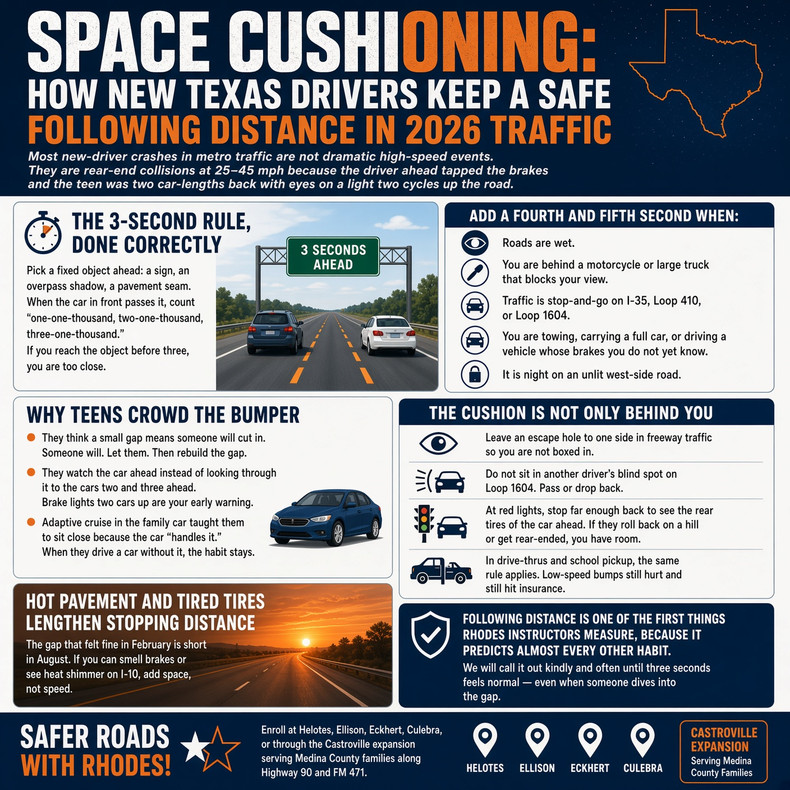
Most new-driver crashes in metro traffic are not dramatic high-speed events. They are rear-end collisions at 25–45 mph because the driver ahead tapped the brakes and the teen was two car-lengths back with eyes on a light two cycles up the road.
Space cushioning — the 3-second (or more) following gap, plus room on both sides — is the cheapest safety feature you can install. It costs only patience.
The 3-second rule, done correctly
Pick a fixed object ahead: a sign, an overpass shadow, a pavement seam. When the car in front passes it, count “one-one-thousand, two-one-thousand, three-one-thousand.” If you reach the object before three, you are too close.
Add a fourth and fifth second when:
- Roads are wet.
- You are behind a motorcycle or large truck that blocks your view.
- Traffic is stop-and-go on I-35, Loop 410, or Loop 1604.
- You are towing, carrying a full car, or driving a vehicle whose brakes you do not yet know.
- It is night on an unlit west-side road.
Why teens crowd the bumper
- They think a small gap means someone will cut in. Someone will. Let them. Then rebuild the gap.
- They watch the car ahead instead of looking through it to the cars two and three ahead. Brake lights two cars up are your early warning.
- Adaptive cruise in the family car taught them to sit close because the car “handles it.” When they drive a car without it, the habit stays.
The cushion is not only behind you
- Leave an escape hole to one side in freeway traffic so you are not boxed in.
- Do not sit in another driver’s blind spot on Loop 1604. Pass or drop back.
- At red lights, stop far enough back to see the rear tires of the car ahead. If they roll back on a hill or get rear-ended, you have room.
- In drive-thrus and school pickup, the same rule applies. Low-speed bumps still hurt and still hit insurance.
Hot pavement and tired tires lengthen stopping distance. The gap that felt fine in February is short in August. If you can smell brakes or see heat shimmer on I-10, add space, not speed.
Following distance is one of the first things Rhodes instructors measure, because it predicts almost every other habit. We will call it out kindly and often until three seconds feels normal — even when someone dives into the gap.
Safer Roads with Rhodes! Enroll at Helotes, Ellison, Eckhert, Culebra, or through the Castroville expansion serving Medina County families along Highway 90 and FM 471.