
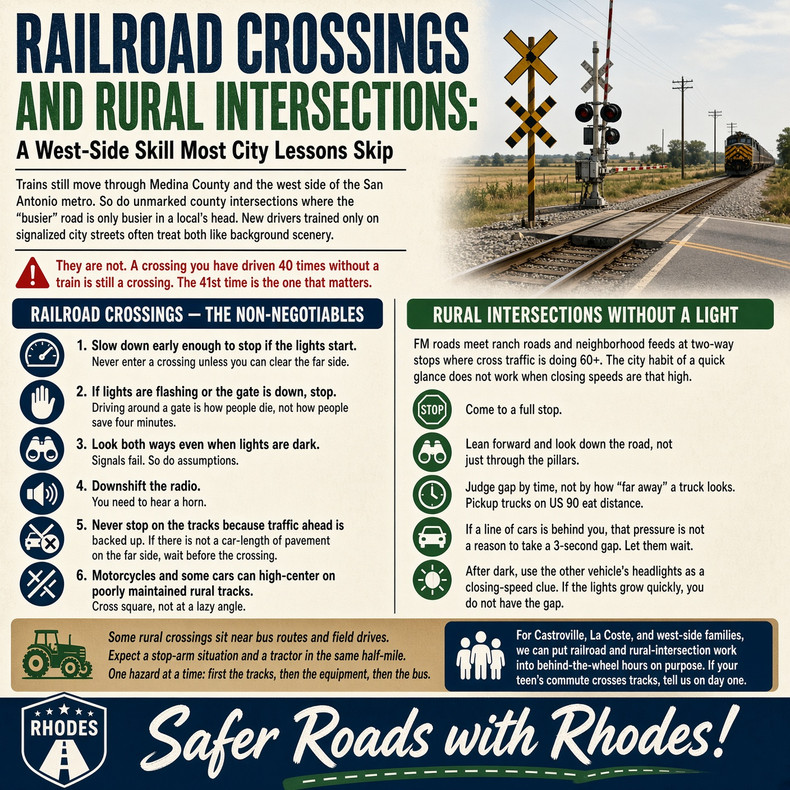
Trains still move through Medina County and the west side of the San Antonio metro. So do unmarked county intersections where the “busier” road is only busier in a local’s head. New drivers trained only on signalized city streets often treat both like background scenery.
They are not. A crossing you have driven 40 times without a train is still a crossing. The 41st time is the one that matters.
Railroad crossings — the non-negotiables
- Slow down early enough to stop if the lights start. Never enter a crossing unless you can clear the far side.
- If lights are flashing or the gate is down, stop. Driving around a gate is how people die, not how people save four minutes.
- Look both ways even when lights are dark. Signals fail. So do assumptions.
- Downshift the radio. You need to hear a horn.
- Never stop on the tracks because traffic ahead is backed up. If there is not a car-length of pavement on the far side, wait before the crossing.
- Motorcycles and some cars can high-center on poorly maintained rural tracks. Cross square, not at a lazy angle.
Rural intersections without a light
FM roads meet ranch roads and neighborhood feeds at two-way stops where cross traffic is doing 60+. The city habit of a quick glance does not work when closing speeds are that high.
- Come to a full stop.
- Lean forward and look down the road, not just through the pillars.
- Judge gap by time, not by how “far away” a truck looks. Pickup trucks on US 90 eat distance.
- If a line of cars is behind you, that pressure is not a reason to take a 3-second gap. Let them wait.
- After dark, use the other vehicle’s headlights as a closing-speed clue. If the lights grow quickly, you do not have the gap.
Some rural crossings sit near bus routes and field drives. Expect a stop-arm situation and a tractor in the same half-mile. One hazard at a time: first the tracks, then the equipment, then the bus.
For Castroville, La Coste, and west-side families, we can put railroad and rural-intersection work into behind-the-wheel hours on purpose. If your teen’s commute crosses tracks, tell us on day one.
Safer Roads with Rhodes!