
Texas requires teen drivers to log 30 hours of supervised practice — 20 hours during the day and 10 hours at night — with a parent, legal guardian, or a licensed adult 21 or older who has held a valid Texas license for at least one year. The log is not busywork. Those hours are where classroom rules become reflexes.
Too many families treat the log like a checkbox: the same neighborhood loop, the same grocery-store parking lot, the same daylight hours. Then the first night on Loop 1604 feels like a different sport.
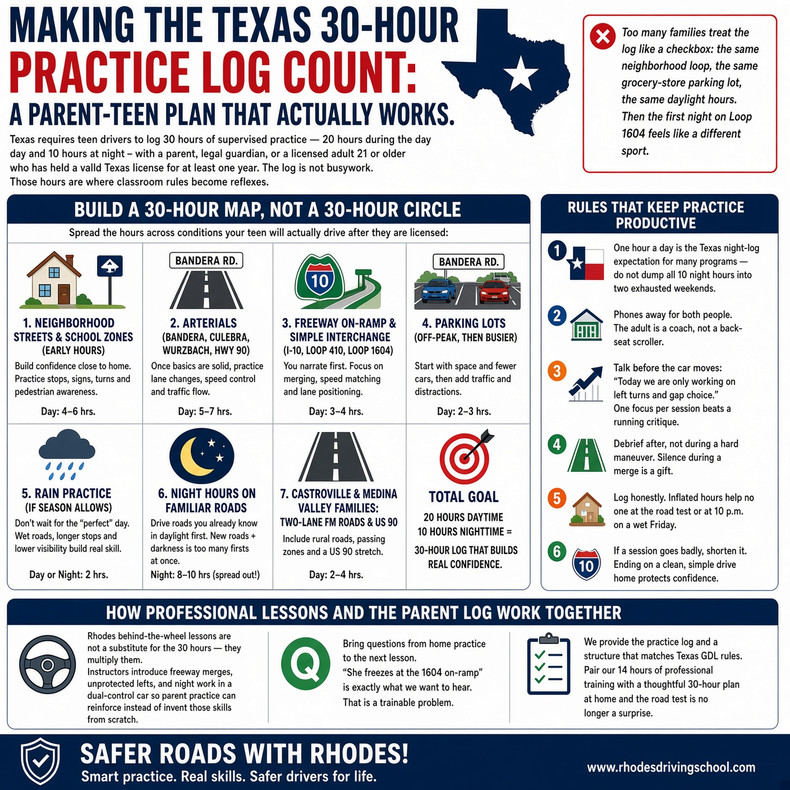
Build a 30-hour map, not a 30-hour circle
Spread the hours across conditions your teen will actually drive after they are licensed:
- Neighborhood streets and school zones (early hours).
- Arterials such as Bandera, Culebra, Wurzbach, or Highway 90 (once basics are solid).
- A freeway on-ramp and a simple interchange — I-10, Loop 410, or Loop 1604 — with you narrating first.
- A crowded parking lot at an off-peak time, then a busier one.
- At least some rain if the season allows. Waiting for a “perfect day” wastes the log.
- Night hours on roads the teen already knows in daylight. New roads plus darkness is too many firsts at once.
- For Castroville and Medina Valley families: at least a few hours on two-lane FM roads and a US 90 stretch.
Rules that keep practice productive
- One hour a day is the Texas night-log expectation for many programs — do not dump all 10 night hours into two exhausted weekends.
- Phones away for both people. The adult is a coach, not a back-seat scroller.
- Talk before the car moves: “Today we are only working on left turns and gap choice.” One focus per session beats a running critique.
- Debrief after, not during a hard maneuver. Silence during a merge is a gift.
- Log honestly. Inflated hours help no one at the road test or at 10 p.m. on a wet Friday.
- If a session goes badly, shorten it. Ending on a clean, simple drive home protects confidence.
How professional lessons and the parent log work together
Rhodes behind-the-wheel lessons are not a substitute for the 30 hours — they multiply them. Instructors introduce freeway merges, unprotected lefts, and night work in a dual-control car so parent practice can reinforce instead of invent those skills from scratch.
Bring questions from home practice to the next lesson. “She freezes at the 1604 on-ramp” is exactly what we want to hear. That is a trainable problem.
We provide the practice log and a structure that matches Texas GDL rules. Pair our 14 hours of professional training with a thoughtful 30-hour plan at home and the road test is no longer a surprise.
Safer Roads with Rhodes!