
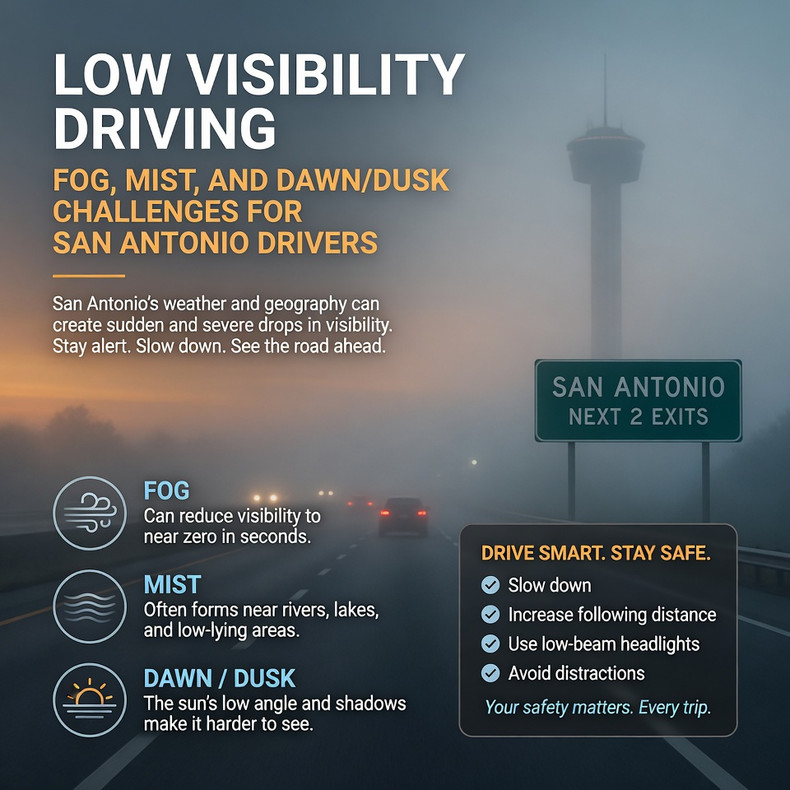
Low visibility is one of the most underestimated hazards for new drivers in San Antonio. Early morning fog near the Medina River and western areas, mist that lingers after summer thunderstorms, and the longer dawn and dusk periods in fall and winter all reduce how far ahead you can see. When visibility drops, reaction time shrinks and the risk of rear-end collisions or running into stopped vehicles rises quickly.
Many new drivers continue at normal speeds because the road “feels” familiar. That is exactly when trouble happens. Learning to adjust speed, lighting, and following distance is a critical defensive driving skill.
Here is how San Antonio drivers can handle fog, mist, and low-light conditions safely:
- Slow down the moment visibility decreases. If you cannot clearly see at least 100 yards ahead, you are driving too fast for the conditions. Reduce speed until you have time to react to whatever appears in front of you.
- Use low-beam headlights only. High beams reflect off fog and mist, creating glare that makes it harder to see. Low beams aim the light downward and improve visibility for you and other drivers. Turn headlights on whenever conditions are less than clear — do not wait for full darkness.
- Increase your following distance. Switch from the usual three-second gap to four seconds or more. In heavy fog or mist you may need even more space. The extra distance gives you time to stop if the vehicle ahead brakes suddenly.
- Avoid sudden lane changes and hard braking. Smooth, predictable movements are safer when other drivers also have limited visibility. Signal early and make gradual adjustments.
- Know when to pull off the road. If visibility drops so low that you cannot safely continue, exit the travel lanes completely. Find a safe parking area or wide shoulder, turn on your hazard lights, and wait until conditions improve. Never stop in a travel lane.
- Keep your windshield and headlights clean. Dirt, film, and bugs on glass scatter light and make fog or mist much worse. Clean the outside of the windshield and headlights regularly, and make sure your wipers are in good condition.
- Stay alert for stopped vehicles and debris. In low visibility you may not see a stalled car, road debris, or a vehicle that has already pulled over until you are very close. Scan farther ahead than usual and be ready to react.
- Use the right edge of the road as a guide when needed. In very thick fog, the painted edge line or the shoulder can help you stay oriented. Avoid staring only at the lights of the car ahead, which can pull you off your intended path.
- Be especially careful at dawn and dusk. These transition periods combine lower light with higher traffic volumes as people head to or from work and school. Headlights and extra scanning make a measurable difference.
At Rhodes Driving Schools, instructors deliberately include lower-visibility practice whenever conditions allow. Classroom discussion of fog and night driving is useful, but real experience behind the wheel with a patient instructor builds the judgment new drivers need when the weather turns.
Safer Roads with Rhodes! Build real-world low-visibility skills at any of our four San Antonio locations — Helotes, Ellison, Eckhert, or Culebra. Visit rhodesdrivingschools.com or call to schedule lessons.