
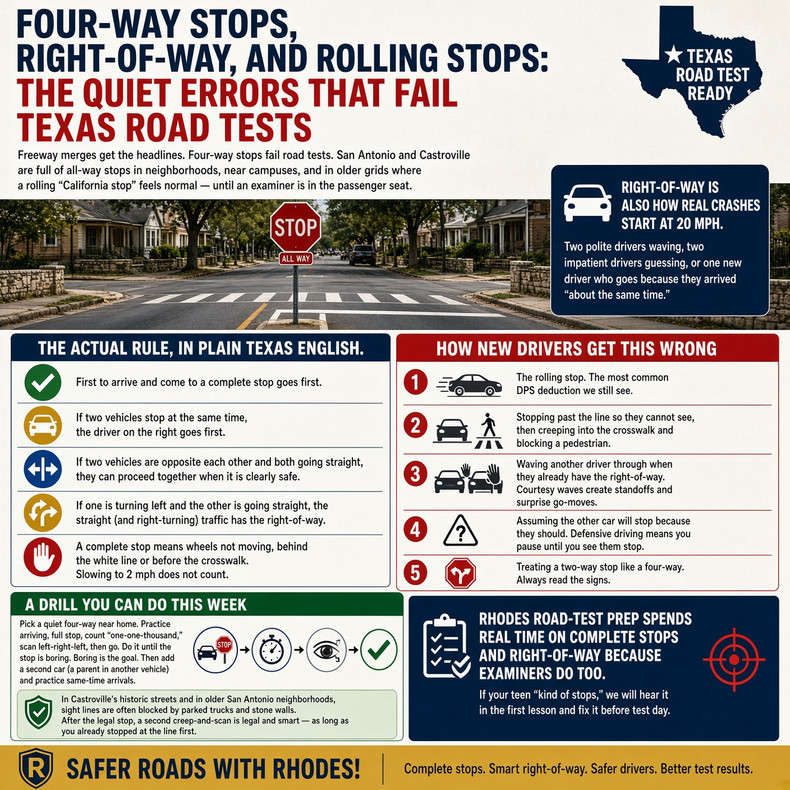
Freeway merges get the headlines. Four-way stops fail road tests. San Antonio and Castroville are full of all-way stops in neighborhoods, near campuses, and in older grids where a rolling “California stop” feels normal — until an examiner is in the passenger seat.
Right-of-way is also how real crashes start at 20 mph: two polite drivers waving, two impatient drivers guessing, or one new driver who goes because they arrived “about the same time.”
The actual rule, in plain Texas English
- First to arrive and come to a complete stop goes first.
- If two vehicles stop at the same time, the driver on the right goes first.
- If two vehicles are opposite each other and both going straight, they can proceed together when it is clearly safe.
- If one is turning left and the other is going straight, the straight (and right-turning) traffic has the right-of-way.
- A complete stop means wheels not moving, behind the white line or before the crosswalk. Slowing to 2 mph does not count.
How new drivers get this wrong
- The rolling stop. The most common DPS deduction we still see.
- Stopping past the line so they cannot see, then creeping into the crosswalk and blocking a pedestrian.
- Waving another driver through when they already have the right-of-way. Courtesy waves create standoffs and surprise go-moves.
- Assuming the other car will stop because they should. Defensive driving means you pause until you see them stop.
- Treating a two-way stop like a four-way. Always read the signs.
A drill you can do this week
Pick a quiet four-way near home. Practice arriving, full stop, count “one-one-thousand,” scan left-right-left, then go. Do it until the stop is boring. Boring is the goal. Then add a second car (a parent in another vehicle) and practice same-time arrivals.
In Castroville’s historic streets and in older San Antonio neighborhoods, sight lines are often blocked by parked trucks and stone walls. After the legal stop, a second creep-and-scan is legal and smart — as long as you already stopped at the line first.
Rhodes road-test prep spends real time on complete stops and right-of-way because examiners do too. If your teen “kind of stops,” we will hear it in the first lesson and fix it before test day.
Safer Roads with Rhodes!