
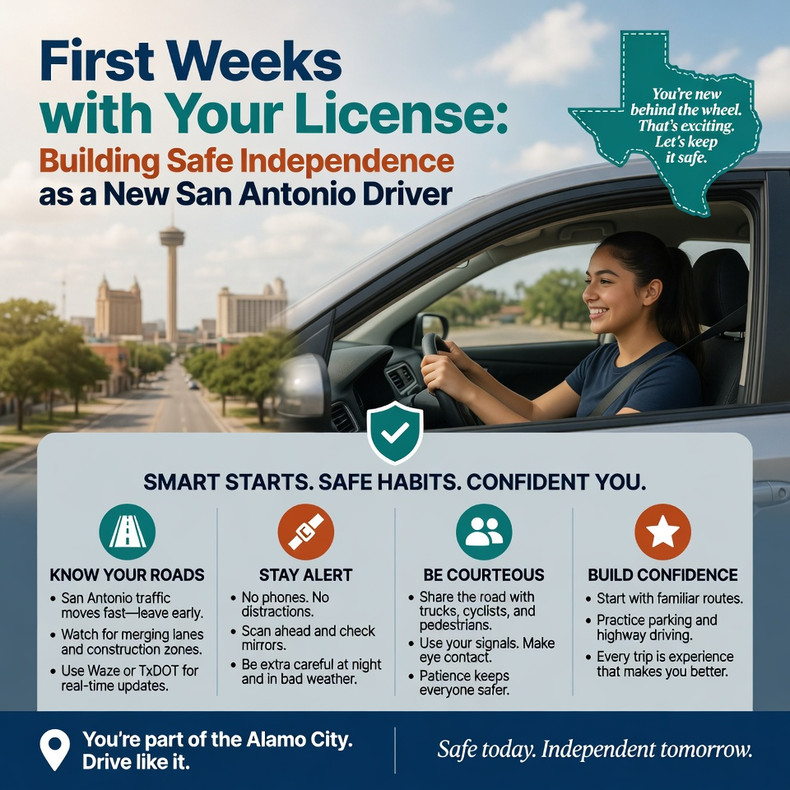
Earning a Texas provisional license is a major milestone. For many San Antonio teens it means new freedom — driving to school, work, practices, or to meet friends without a parent in the passenger seat. It is also one of the highest-risk periods in a new driver’s life. Crash rates are elevated in the first months after licensing as teens begin driving more often, in more varied conditions, and with less direct supervision.
The habits formed in the first 30 to 90 days tend to stick. Drivers who start with careful limits, strong focus, and honest self-assessment usually carry those habits forward. Drivers who immediately push boundaries often pay for it with close calls, tickets, or worse.
Here are practical guidelines for the first weeks of licensed driving in San Antonio:
- Limit night driving and long freeway trips at first. Night driving and high-speed freeways such as I-35, Loop 410, and US 281 add complexity. Build confidence on familiar daytime roads before adding these challenges.
- Avoid driving when tired, emotional, or rushed. Fatigue, anger, stress, or running late all reduce attention and increase risk. If you are not in a good mental state to drive, wait or find another ride.
- Keep strict phone and passenger rules even after legal restrictions ease. Just because a restriction has legally ended does not mean the risk has disappeared. Many families continue a one-passenger limit and a full phone ban for several additional months.
- Share your route and expected return time with a parent. A quick text or conversation before leaving creates accountability and gives parents peace of mind. It also makes it easier to get help if something unexpected happens.
- Use “commentary driving.” Say out loud what you see and what you plan to do: “Car on the right is slowing… I’m checking my mirror before changing lanes… light is turning yellow, I’m stopping.” This habit keeps your attention active and helps parents or instructors coach more effectively when they ride along.
- Review close calls honestly. Every near-miss is useful information. Talk through what happened with a parent or instructor and decide what you will do differently next time. Treating close calls as learning opportunities prevents them from becoming real crashes.
- Focus on safe miles, not just arrival. Getting to the destination is not the only measure of success. Arriving without rushing, without distraction, and without creating risk for others is the real goal.
- Continue supervised practice when possible. Even after licensing, occasional drives with a parent or a professional instructor help refine skills and catch developing bad habits early.
- Respect the learning curve. Confidence is good. Overconfidence is dangerous. The best new drivers stay slightly cautious and keep improving long after the license is in their wallet.
At Rhodes Driving Schools we prepare students for this exact transition. Our behind-the-wheel lessons and decision-making focus give new drivers a stronger foundation so the first weeks of independence are safer and less stressful for everyone.
Safer Roads with Rhodes! Whether you are just starting or want to strengthen skills after licensing, our four San Antonio locations — Helotes, Ellison, Eckhert, and Culebra — are ready to help. Visit rhodesdrivingschools.com to learn more.