
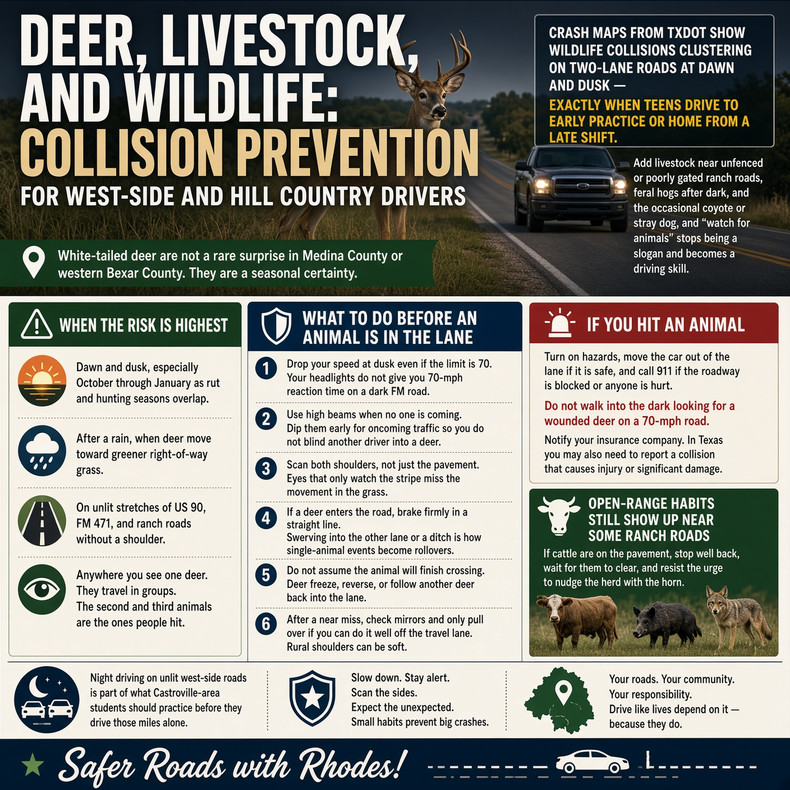
White-tailed deer are not a rare surprise in Medina County or western Bexar County. They are a seasonal certainty. Crash maps from TxDOT show wildlife collisions clustering on two-lane roads at dawn and dusk — exactly when teens drive to early practice or home from a late shift.
Add livestock near unfenced or poorly gated ranch roads, feral hogs after dark, and the occasional coyote or stray dog, and “watch for animals” stops being a slogan and becomes a driving skill.
When the risk is highest
- Dawn and dusk, especially October through January as rut and hunting seasons overlap.
- After a rain, when deer move toward greener right-of-way grass.
- On unlit stretches of US 90, FM 471, and ranch roads without a shoulder.
- Anywhere you see one deer. They travel in groups. The second and third animals are the ones people hit.
What to do before an animal is in the lane
- Drop your speed at dusk even if the limit is 70. Your headlights do not give you 70-mph reaction time on a dark FM road.
- Use high beams when no one is coming. Dip them early for oncoming traffic so you do not blind another driver into a deer.
- Scan both shoulders, not just the pavement. Eyes that only watch the stripe miss the movement in the grass.
- If a deer enters the road, brake firmly in a straight line. Swerving into the other lane or a ditch is how single-animal events become rollovers.
- Do not assume the animal will finish crossing. Deer freeze, reverse, or follow another deer back into the lane.
- After a near miss, check mirrors and only pull over if you can do it well off the travel lane. Rural shoulders can be soft.
If you hit an animal
Turn on hazards, move the car out of the lane if it is safe, and call 911 if the roadway is blocked or anyone is hurt. Do not walk into the dark looking for a wounded deer on a 70-mph road. Notify your insurance company. In Texas you may also need to report a collision that causes injury or significant damage.
Open-range habits still show up near some ranch roads. If cattle are on the pavement, stop well back, wait for them to clear, and resist the urge to nudge the herd with the horn.
Night driving on unlit west-side roads is part of what Castroville-area students should practice before they drive those miles alone.
Safer Roads with Rhodes!