
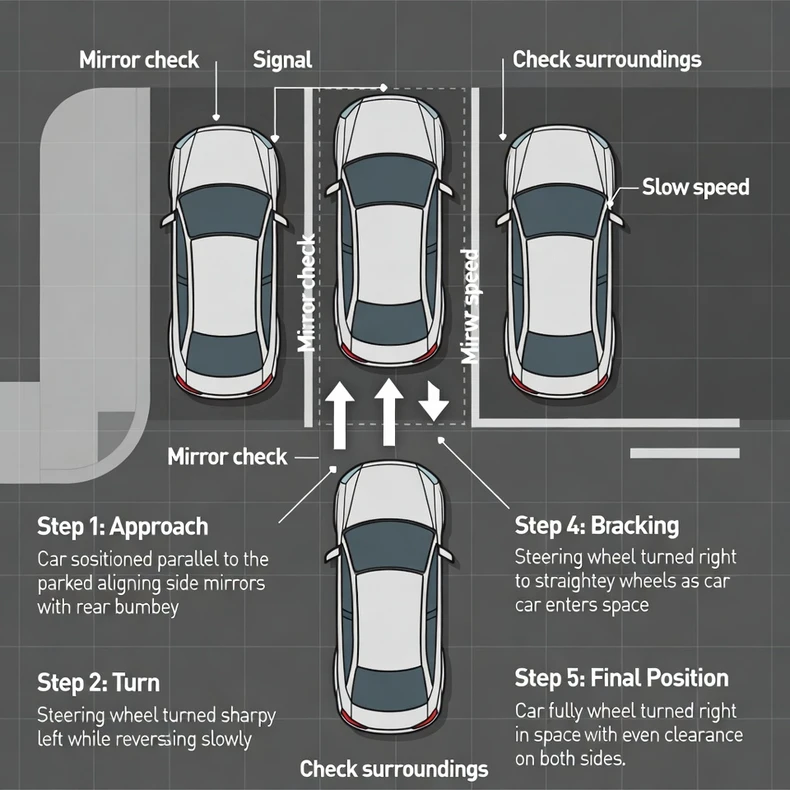
Parallel parking remains one of the most challenging skills for new and teen drivers in San Antonio. Many Texas DPS road test failures involve parking maneuvers, and the ability to park confidently between vehicles is essential for everyday driving in neighborhoods, shopping areas, and busy streets around Helotes, Ellison, Eckhert, and Culebra.
The good news is that parallel parking follows a repeatable set of steps and reference points that make it predictable and manageable with practice. Texas DPS examiners look for smooth control, proper observation, and safe positioning without striking curbs or vehicles.
Key Facts About Parallel Parking on the Texas DPS Test
- You must park within 18 inches of the curb.
- The maneuver must be completed in one continuous motion (no excessive backing and pulling forward).
- Examiners evaluate observation (mirror and blind spot checks), vehicle control, and final positioning.
- Common deductions include touching the curb, hitting imaginary vehicles, or leaving the vehicle too far from the curb.
- In real-world San Antonio driving, tight parking spots on residential streets and near commercial areas require precise control.
Step-by-Step Parallel Parking Method (2026 Texas Standards)
1. Preparation and Positioning
- Signal and position your vehicle parallel to the car in front of the open spot, about 2–3 feet away.
- Align your rear bumper with the rear bumper of the front vehicle.
- Check mirrors and blind spots thoroughly before beginning.
2. The Backing Maneuver
- Shift into reverse and turn the steering wheel sharply toward the curb (usually 1–1.5 turns).
- Back up slowly while checking your rear and side mirrors.
- Stop when your front door aligns with the rear bumper of the front vehicle (or when your vehicle is at a 45-degree angle).
3. Straightening the Vehicle
- Straighten the steering wheel and continue backing slowly.
- Monitor the distance to the rear vehicle using your mirrors.
- Stop when your front bumper clears the rear of the front vehicle and your rear bumper clears the front of the rear vehicle.
4. Final Adjustments
- Shift into drive and turn the wheel away from the curb.
- Pull forward slowly until centered in the spot.
- Ensure you are within 18 inches of the curb and not blocking traffic.
- Set the parking brake and shift to Park.
5. Exiting the Spot
- Signal, check blind spots, and pull out smoothly when safe.
Additional Solutions & Practice Tips
- Use Reference Points: Learn your vehicle’s specific sight lines (many instructors teach using door handles or mirrors as guides).
- Start Slow: Practice at very low speeds (under 5 mph) to build muscle memory and control.
- Practice in Stages: Master positioning first, then the full maneuver. Use cones or empty parking lot lines before real vehicles.
- Common Fixes:
- Too close to curb → Start farther out.
- Too far from curb → Turn steering wheel more sharply.
- Hitting imaginary front car → Begin backing earlier.
- Practice on streets with varying parking spot sizes around San Antonio to build adaptability.
- Focus on continuous observation: Check all mirrors and blind spots multiple times during the maneuver.
Consistent, deliberate practice turns parallel parking from a stressful test requirement into a routine skill. Professional instruction with dual-control vehicles allows you to receive immediate feedback and safely repeat the maneuver until it feels natural.
Ready to Master Parallel Parking? Start applying these step-by-step techniques on San Antonio roads today.
Park with confidence, The Rhodes Team Rhodes Driving Schools – San Antonio, TX