
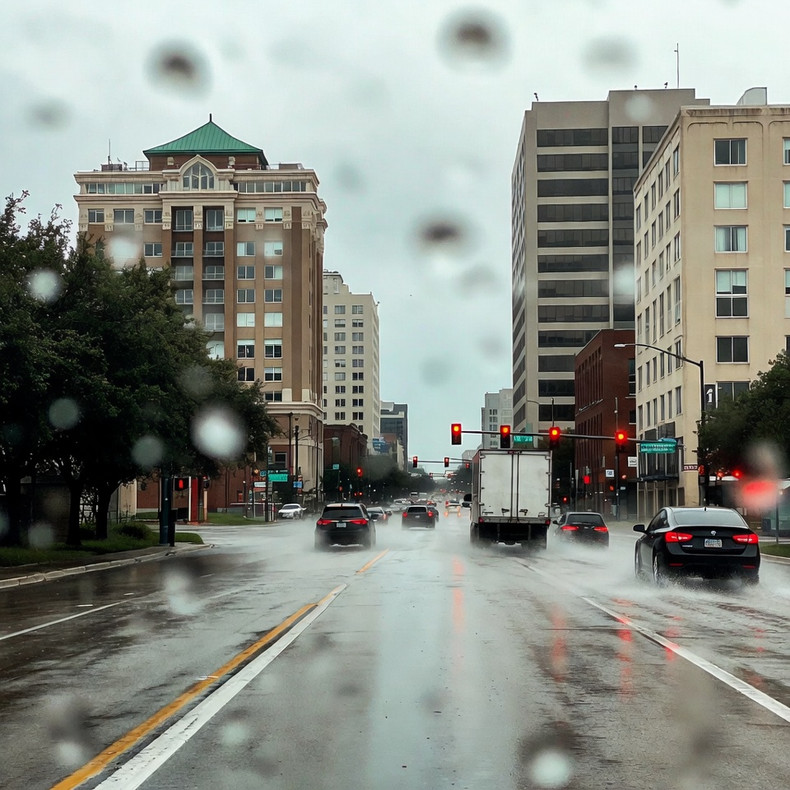
San Antonio summers and springs often bring sudden, intense rainstorms that turn roads slick and create dangerous flash flooding. For new and teen drivers, rainy day driving adds extra challenges: reduced visibility, longer stopping distances, and the risk of hydroplaning.If you’re searching for rainy day driving tips San Antonio or practical advice on driving in rain Texas, this guide from Rhodes Driving Schools will help you stay safe and confident when the skies open up.Texas weather can change fast — being prepared makes all the difference between a stressful drive and a safe one.1. Why Rain Makes Driving More Dangerous in San AntonioThe first 30 minutes of rain are often the most hazardous because oil and grease on the road mix with water, creating a slippery surface.Common risks in South Texas:
- Hydroplaning — when tires lose contact with the road and ride on a film of water
- Reduced visibility from heavy rain and spray from other vehicles
- Flash flooding in low-lying areas, underpasses, and intersections common around San Antonio
- Longer stopping distances — it can take twice as long to stop on wet roads
- Increased chance of multi-vehicle accidents on busy highways like I-35, Loop 410, and US 281
- Slow down: Reduce your speed by at least 5–10 mph below the posted limit. Never drive at normal dry-road speeds.
- Increase following distance: Double or triple your normal gap (aim for 6+ seconds) to allow extra reaction time.
- Turn on headlights: Use low beams (not high beams) so other drivers can see you better. Daytime running lights alone are usually not enough.
- Avoid sudden movements: Brake, accelerate, and steer smoothly and gradually. Jerky actions increase the chance of losing control.
- Use your wipers and defroster: Keep your windshield clear and windows fog-free.
- Keep tires properly inflated and with adequate tread depth (replace when tread is below 4/32 inch).
- Avoid driving in heavy rain if you’re still building confidence — pull over safely or delay the trip.
- Stay in the center of the lane where water is less likely to pool.
- Do not use cruise control in the rain.
- Stay calm — do not slam on the brakes or turn the wheel sharply.
- Ease off the accelerator gently and hold the steering wheel straight.
- Once tires regain traction, steer smoothly in the direction you want to go.
- Avoid braking until you have full control again.
- Never drive through flooded roads or standing water — even 6 inches of moving water can float most cars.
- Avoid low-water crossings and dips in roads during or after heavy rain.
- Watch for “High Water” signs and barricades — they are there for a reason.
- If water covers the road, find an alternate route or wait it out. It’s far better to be late than risk your life.
- On I-35, Loop 410, and I-10: Increase following distance significantly and watch for large trucks that create heavy spray.
- In residential neighborhoods: Watch for hidden potholes filled with water that can damage tires or cause loss of control.
- At intersections: Allow extra time to stop — wet roads make it easier to slide through stop signs or red lights.
- Construction zones: These become even more hazardous in rain. Slow down early and expect sudden lane shifts.
- Check weather before leaving: Use apps to monitor radar, especially during afternoon thunderstorm season.
- Clean your vehicle: Ensure wipers, headlights, and taillights are in good condition before rainy season.
- Avoid distractions: Keep phone use to hands-free only (or better, none at all) when visibility is low.
- Pull over safely if needed: If rain becomes a downpour and visibility drops dangerously, activate hazard lights and pull into a safe, well-lit parking area.
- Night rain combination: Reduce speed even more — glare from wet roads plus rain makes everything harder.
Contact us today to schedule lessons with a focus on defensive driving in wet conditions:
- Helotes: (210) 695-8883
- Ellison: (210) 680-3980
- Eckhert: (210) 523-7483
Safer Roads with Rhodes!