
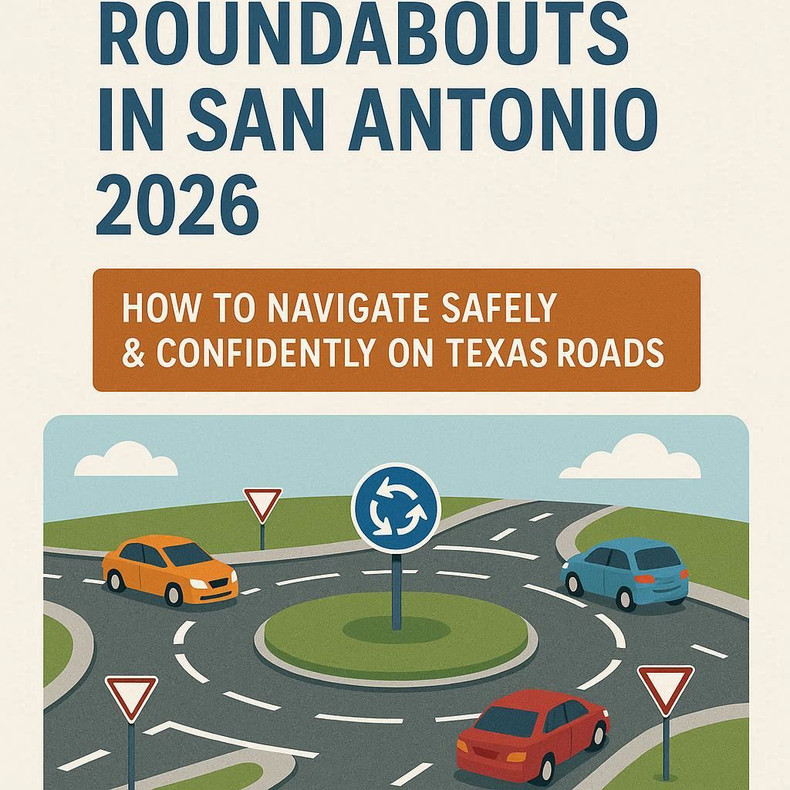
Roundabouts (also called traffic circles) are increasingly common in San Antonio, thanks to TxDOT projects like the US 90 Expansion (adding one at Ray Ellison Blvd/Hunt Lane in 2026 phases), Loop 1604/I-10 interchange upgrades, and others replacing signals for better flow and safety. Texas now has over 660 roundabouts statewide, and San Antonio has dozens—from classics like McCullough Ave/Olmos Dr in Olmos Park to newer ones in suburban areas.Many drivers hesitate or make mistakes, but roundabouts reduce fatalities by over 90%, injuries by 76%, and all crashes by 35% compared to traditional intersections (per FHWA and TxDOT data). They eliminate dangerous T-bone crashes, force slower speeds (15–30 mph entry), and keep traffic moving. At Rhodes Driving Schools, our courses demystify roundabouts San Antonio 2026 with simulator practice and real-road tips—helping students master them quickly.Texas Roundabout Rules 2026: The Basics from TxDOT & Driver HandbookModern roundabouts follow these core principles (counterclockwise flow, yield-at-entry):
- Approach slowly: Reduce speed to 15–25 mph as you near the yield sign/markings.
- Choose the correct lane first: Use signs, arrows, and pavement markings before entering.
- Right lane: For right turns or straight through (in multi-lane).
- Left lane: For left turns or straight through (in multi-lane).
- Don't change lanes inside the circle—stay in your lane until exiting.
- Yield to traffic already circulating: Give way to vehicles in the roundabout (left side). Enter only when there's a safe gap—no need to stop if clear.
- Signal your exit: Use right turn signal as you approach your exit to alert others.
- Pedestrians & cyclists: Yield to them in crosswalks before entering/exiting.
- Large vehicles: Give trucks/buses space—they may need to swing wide or use truck aprons.
- Slow down & prepare: Watch for yellow warning signs and lane markings. Choose your lane early based on your exit (straight, right, left).
- Yield properly: Look left—yield to all circulating traffic. Pedestrians first in crosswalks.
- Enter smoothly: Accelerate gently into a safe gap. Maintain steady speed (no sudden stops).
- Navigate the circle: Stay in your lane; follow the curve counterclockwise.
- Exit correctly: Signal right, exit smoothly. Yield to pedestrians again if needed.
- Right lane → right turn or straight.
- Left lane → left turn or straight.
- Through drivers can use either lane if safe.
- McCullough Ave & Olmos Dr/El Prado Dr (Olmos Park) – One of the oldest modern ones; great for single-lane practice.
- Blanco Rd & Fulton Ave – Retrofitted in 2007; handles school-area traffic safely.
- Upcoming/newer: Ray Ellison Blvd/Hunt Lane (US 90 project, phasing 2026); Loop 1604/I-10 area improvements.
- Others: Check local maps or TxDOT for spots like Wildhorse Pkwy/Mustang Gate or Fairfield areas.
- Safer: 90%+ fatality drop, fewer severe injuries—no head-on or high-speed angle crashes.
- Faster flow: Less idling/waiting than red lights; reduces congestion on busy corridors.
- Pedestrian-friendly: Shorter crossings, lower speeds.
- Eco & cost perks: Less fuel waste, resilient in power outages (no signals).
- Don't stop in the circle—keep moving if safe.
- Avoid cutting across lanes—causes sideswipes.
- Practice in low-traffic times first.
- Our simulators let you "drive" multi-lane scenarios risk-free before real roads.